Category Archives: Across Color Lines

Love Your Class! (Originally Published 2016)

Considerations for Building A Statewide Movement in Pennsylvania – Nijmie Zakkiyyah Dzurinko

Who’s important?

Who’s important in Pennsylvania? Where is it important to build? Prevailing wisdom among liberal and progressive organizing in the state marks off a handful of counties that “matter”, that are “worth being in”. These are counties in the Southeast part of the state (Philadelphia and the collar counties – Bucks, Chester, Delaware, Montgomery), the Lehigh Valley (Allentown, Lehigh, and sometimes Berks),  Allegheny County (where Pittsburgh is) and sometimes York and Dauphin are thrown in for good measure. The significance of these counties is that they are where population is growing as opposed to declining. They have the most people of color, and people in the “new American majority” (people of color, women, youth, immigrants). Therefore, other regions of the state (older, whiter) are not as important. The implication is that they are not the “most directly impacted”. However, if you scratch beneath the surface of this framework what you will see is that it is thinly veiled partisan politicking. It’s simply a matter of who are the most reliable voters for either major political party. Therefore, liberal and progressive groups which are most interested in shoring up votes for Democrats will focus on particular areas and cut their losses elsewhere. Same for the Republican party.  

But where is the most strategic for us to focus? Do we base our calculations in the same way that the Democratic party does? I assert that to do so is our peril and renders us obsolete as an independent political force in Pennsylvania. For us, there is no Philadelphia without Fayette County. There is no center of capital without so many peripheries. And there are no centers of capital without peripheries inside of them.  It’s essential to understand the relationship between the center and the periphery, without becoming distracted and satisfied with the surface level of things. 

The surface level says: more people, more happening (more capital), good. Less people, less happening (less capital), bad. This is the frame that the powers that be have given us. The reality is that every locality in the state has to compete with every other locality, for tax revenue, for investment, for jobs. We cannot fall victim to the illusions of “good” and “bad” places, “good” and “bad” people which map so neatly onto places where there is capital, ie “value”. There can be no real leadership of people that doesn’t understand this fundamental dynamic. So who is important to us? How do we decide who’s important if not by virtue of categories that others use? We decide that the poor and dispossessed are important – of every color, every background, every gender, every age, every religion, every ability, every political persuasion. We unite with them, we ally with them, we go to where they are. We unite them.

Organize all manner of people

The terrain on which we are living is oppressive and it has real material consequences in people’s lives. We all carry the burden of the internalization of the ideologies that accompany and reinforce that oppression. One of the distortions of our time is the belief that you can equate one statement with a fundamental truth about who someone is. This is a false position and an elitist one. By virtue of educational and/or class privilege, some have gone through lots of training in speaking and writing. Our leaders and strategists must be able to distinguish between appearance and reality. Does a sentence or phrase that comes out the wrong way cancel out a lifetime of material struggle? Does it cancel out the sum total of someone’s experiences? Is it an exercise in the same level of power as a Governor who knowingly pollutes the water supply of tens of thousands, or capitalists and elected officials who conspire together to remake a neighborhood or a town as a playground for the rich? Why then do we feel justified to consistently react with even more outrage to verbal incidents from people with little or no structural power?  

Should we be vetting the people that we’re organizing according to their language? Absolutely not. It is only relationally that we can influence them. We have to create our own language and our own approach to dealing with oppression. We’re not throwing out poor and dispossessed people – of all backgrounds – because they carry isms and phobias. There are plenty of people who can pick up those habits and wear them like clothing but they are not part of their core identity. They can take them off when something better comes along that gives them solidarity to replace it with. We’ve seen that shift happen. We want a society without police and prisons yet we criminalize and symbolically lock up people and throw away the key because of their language. We deem them unworthy, we banish them. And some of them are some of the kindest and most loyal friends you could ever imagine. There are some downright horrible people with “good” or “great” politics. They know everything about gender pronouns, they would never say “all lives matter”, they know what’s current, they know what you’re supposed to know when you’re in the know. They are in the very middle of the echo chamber of “progressives”. Yet they act horribly. They’re backstabbers. They’ll throw you under the bus at a moment’s notice. They don’t listen. They don’t even care. They just know the right things to say. This is not the basis on which to organize people or the basis on which to build a movement. 

Visible and invisible violence

There is a power and hegemonic form of violence that has become normalized. It doesn’t always bleed or make news headlines, but it’s the violence baked into the way that we live every day, that we rarely ever face, because it might be too much to do so. There is violence being done to us, and the invisibilized violence we participate in just by virtue of being part of the system that we live in. We, the “good people”, the social justice “activists”, the “organizers”, we do no harm, right? We’re not like the “other people”. But the simple fact of it is, the global economic system that we are living in ensures that there is blood on absolutely everyone’s hands. There is no escaping it. There is no denying it. We get together to do the most radical of radical visioning at a conference paid for by a funder whose ill gotten gains are based on hundreds of years of oppression and exploitation. We are in a setting where workers are forced to work more and more quickly to get rooms cleaned up. They develop health conditions from picking up mattresses, fixing beds and picking things up off the floor in record speed. This is happening all around us, but we can’t even see it because we have tunnel vision. Because we’re “good”. The invisibilized violence of everyday work, of not having access to your basic needs, of waiting at the health center for six hours to be seen, of working without the proper safety equipment, of the quiet expectation of our bodies breaking down before their time, and acceptance of that. That is the horror and the hell of the violence of this system – and only one example. The violence that is normalized, and accepted. Don’t be fooled into thinking that only the most visible forms of violence are the most damaging to our people, or that anyone can claim moral superiority in this system.

Coordination is leadership 

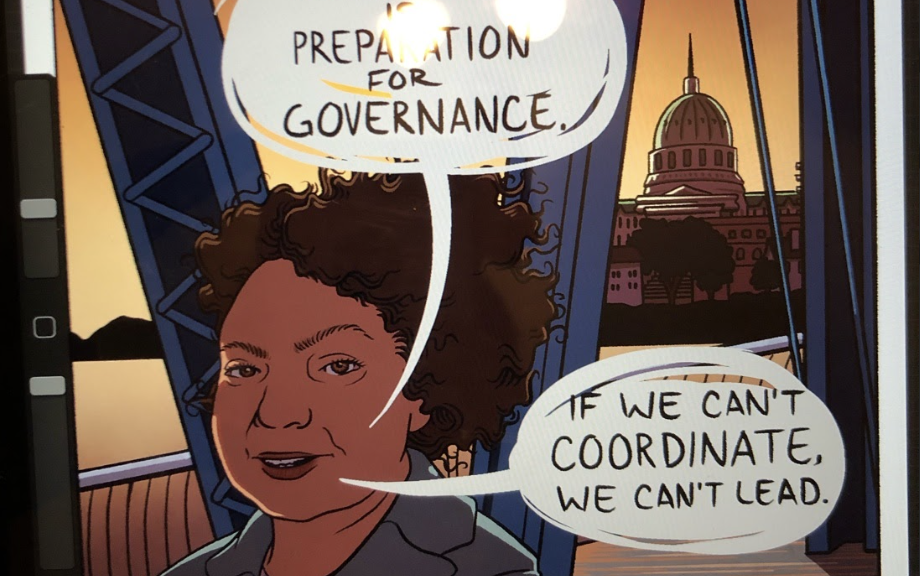
Leadership is lifting up the ideas and accomplishments of people who are not used to having their contributions recognized. It’s noticing when two people at a meeting pass a tray of cookies around and skip over a disabled person as if they weren’t even there. It’s working with someone to understand how to create and carry out a process. It’s making sure that people have the tools they need to get on a conference call. “There are millions of people in this country with little or nothing to lose. If they can be helped to take action together they will do so with a freedom and a power that is a new and unsettling force in our complacent national life.” Leadership is coordination to help people take action together. It’s communication, it’s interaction, it’s documentation, it’s outreach. A mantra of Brazil’s Landless Workers Movement (MST), one of the largest social movements in the world, is: “we all need to learn how to coordinate and be coordinated”. Coordination is not merely women’s work. Coordination is all of our responsibility. Coordination is the lifeblood of social movements. At its best, governance should be coordination. Not making decisions on behalf of people, but coordination of their participation and input. Coordination of processes that allow people to lead, and to be able to fulfill their needs. Coordination is the act of coming together to meet our needs. To organize to meet our needs and to build relationships and build society. Coordination is preparation for governance. If we can’t coordinate, then we can’t lead. How we get from there to here, who’s involved, who’s voice matters, what does the process look like, who does it include and exclude? How do we make sure everyone can participate? These are the questions of coordination. Coordination builds solidarity. 

Devoted to the poor

We want people who are disillusioned with the political process because we want a new political process. We want the people who don’t vote or can’t vote because we can’t vote our way out of the situation that we’re in. We have to be devoted to the poor and dispossessed. Where the poor are, we are. We can’t expect people to come to us, we have to go to them. We have to respect them. We will not win by being “righter” than anyone else. We will not win by shouting down people who disagree with us. We will not win by rejecting people who disagree with us. We will win by welcoming them in. 

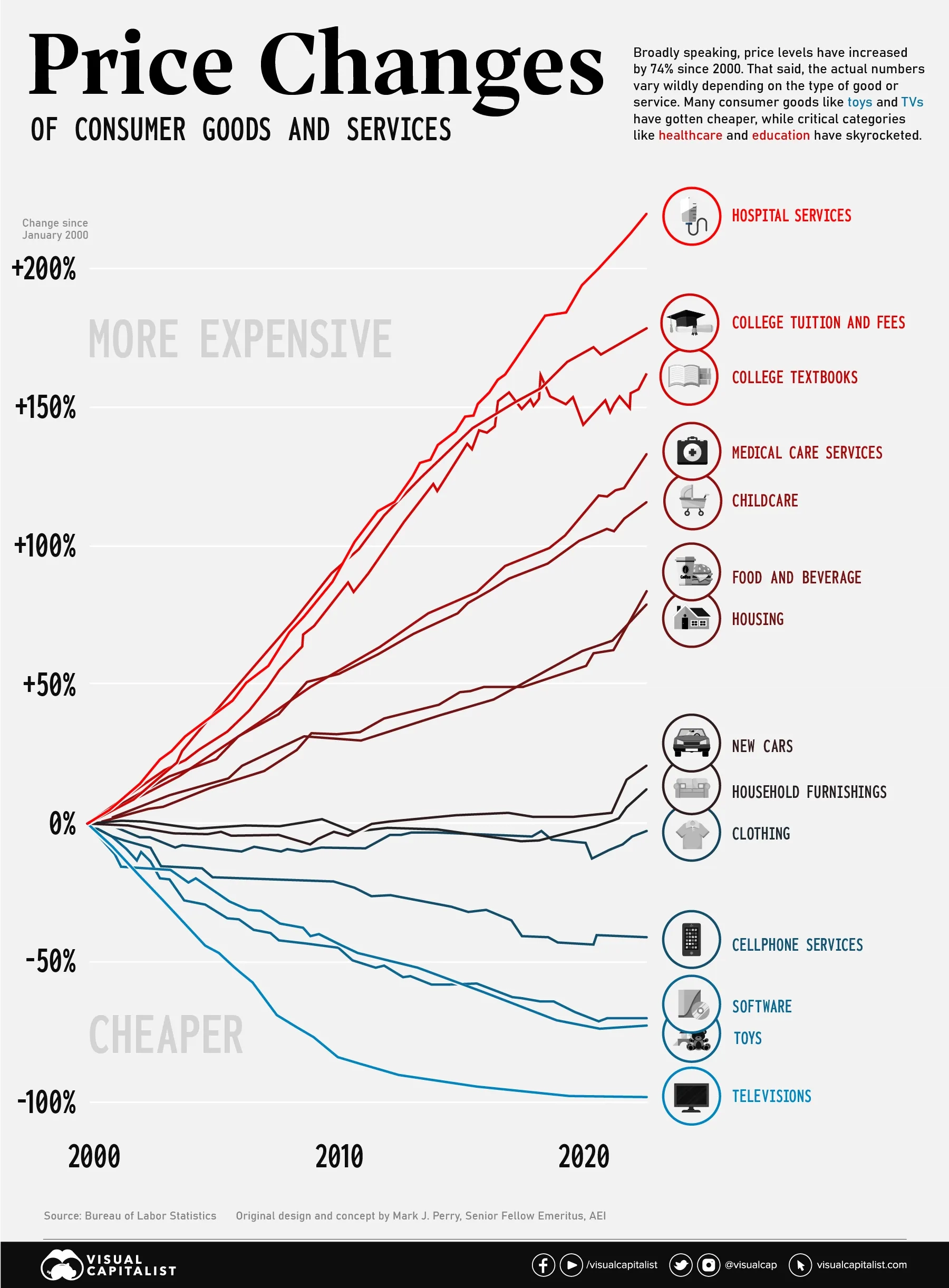
What does the 1% want? If you want to know what the 1% wants, look at what the 1% funds. The rise of the “nonprofit industrial complex” has happened exactly as a new market ascendancy we call neoliberalism has arisen. It has happened exactly as the retrenchment of the state has happened. It has happened as welfare has been gutted, it has happened as public housing has been gutted. The non-profit industrial complex has arisen as productivity has completely been de-coupled from the value that is being created by workers in society. Is this an accident? 

This sector has almost $2 trillion in revenue and employs over 10 million people. A significant part of that sector is based on the idea that the 1% can, through tax write offs, fund what is increasingly a legion of professional organizers and advocates to somehow bring about “social justice”. Another way to look at it as a job creator for a middle strata, a buffer zone of people between the rich and the poor, who make a living for themselves and their families based on the disintegration of society. So how does that 1% then channel our sense of what “social justice” is, our sense of what the solution is? 

Through its funding mechanisms, of course. Where attention goes, energy flows. They cut the issues that are worth caring about and tell us who should care about them and what we should do about it. There’s no place for our strategy and our thinking. They let the world know that funding is available for “x” thing and then we rush out to get it, because it’s our livelihood. What’s not funded doesn’t get worked on. Strategies that they don’t approve don’t get worked on. People they don’t approve of or who don’t fit into their strategy don’t get organized. 

The 1% can tolerate certain kinds of social change. It can tolerate some increasing diversity and representation in its ranks. It can tolerate anything that continues to lead to the Balkanization of the population and slicing up and isolating its potential resistance (which we then play into by fighting each other). It can tolerate moralistic “do-gooder” framing that essentializes certain groups as “good victims” while doing nothing to address the material roots of their oppression. 

It can tolerate us working in issue silos that don’t bring those issues together into a comprehensive understanding of the system. It can tolerate us diminishing the importance of study and leadership development and elevating the importance of short-term mobilization on a repeated cycle, so that we don’t end up with increasingly sophisticated leaders in it for the long haul, but a constantly rotating cast of characters who are initially motivated by some trigger event but then burn out quickly. All these things it can tolerate. These are the waters we are swimming in, and every day in theory and practice we must ask ourselves, how are we outsmarting this strategy?
The Unbearable Heaviness of Quiet Murder

I write this in honor of Michael Parenti – working class hero!

His book, Blackshirts and Reds is one that I recommend to everyone looking to do self-study.

Amid everything that’s going on – it’s been a time of such raw emotion. But what finally broke through the numbness for me was this: 

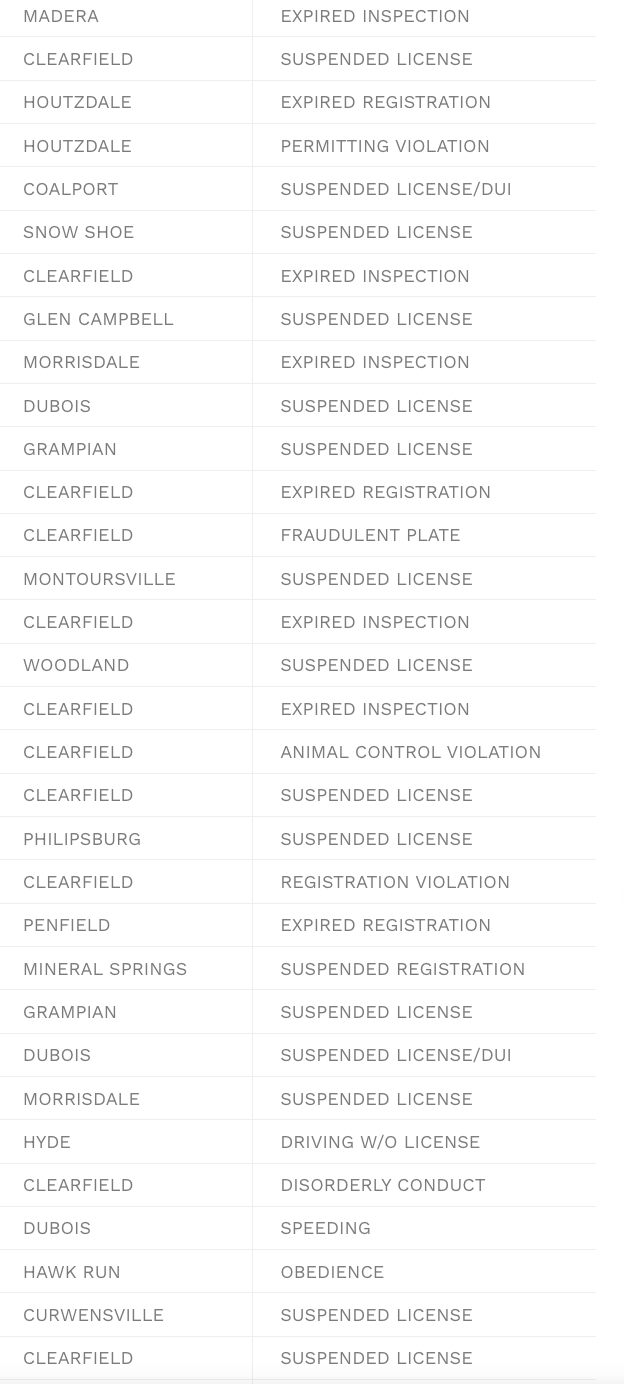
I saw this in my local newsfeed and I couldn’t hold in the tears any longer. It’s from a local news report – presumably placed by “law enforcement” – that lists a bunch of petty infractions (basically, the crime of being too poor to renew your license, get your car inspected, or pay a speeding ticket). What I cropped out of this screenshot is that the news published these peoples’ names. Their NAMES. Their counties. And their “crimes”. Essentially enlisting the help of the public to “hunt them down”. 

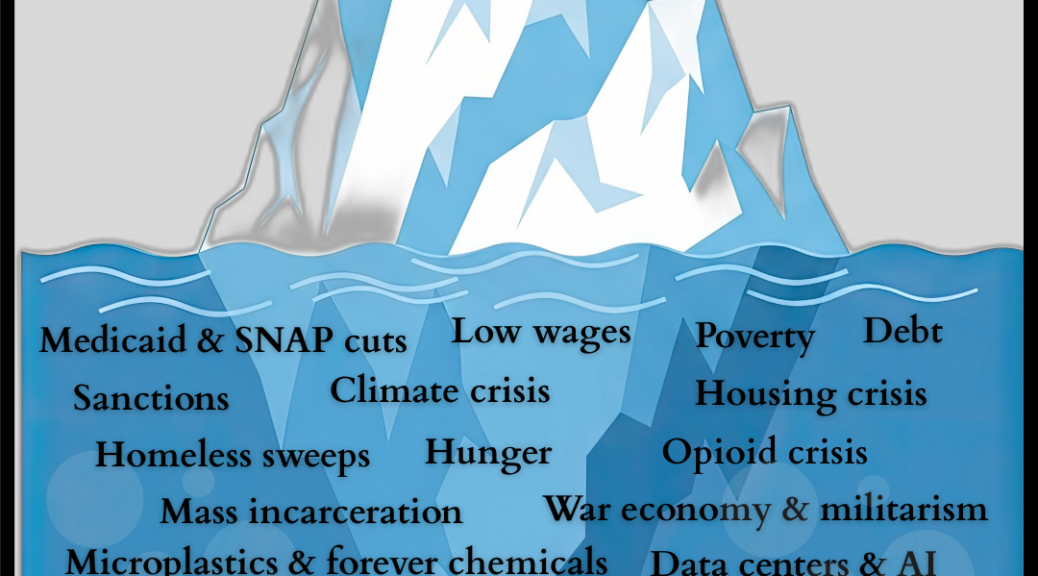
I started riffing some words that come to mind when I think about the condition of our class. Hunted. Disparaged. Slandered. Criminalized. Caged. Ripped apart. Humiliated. Demeaned. Hidden. Disregarded. Exploited. Forgotten. Attacked. Killed. Denied. Oppressed. What comes to mind for you? What are you seeing and experiencing in your community and in your family? 

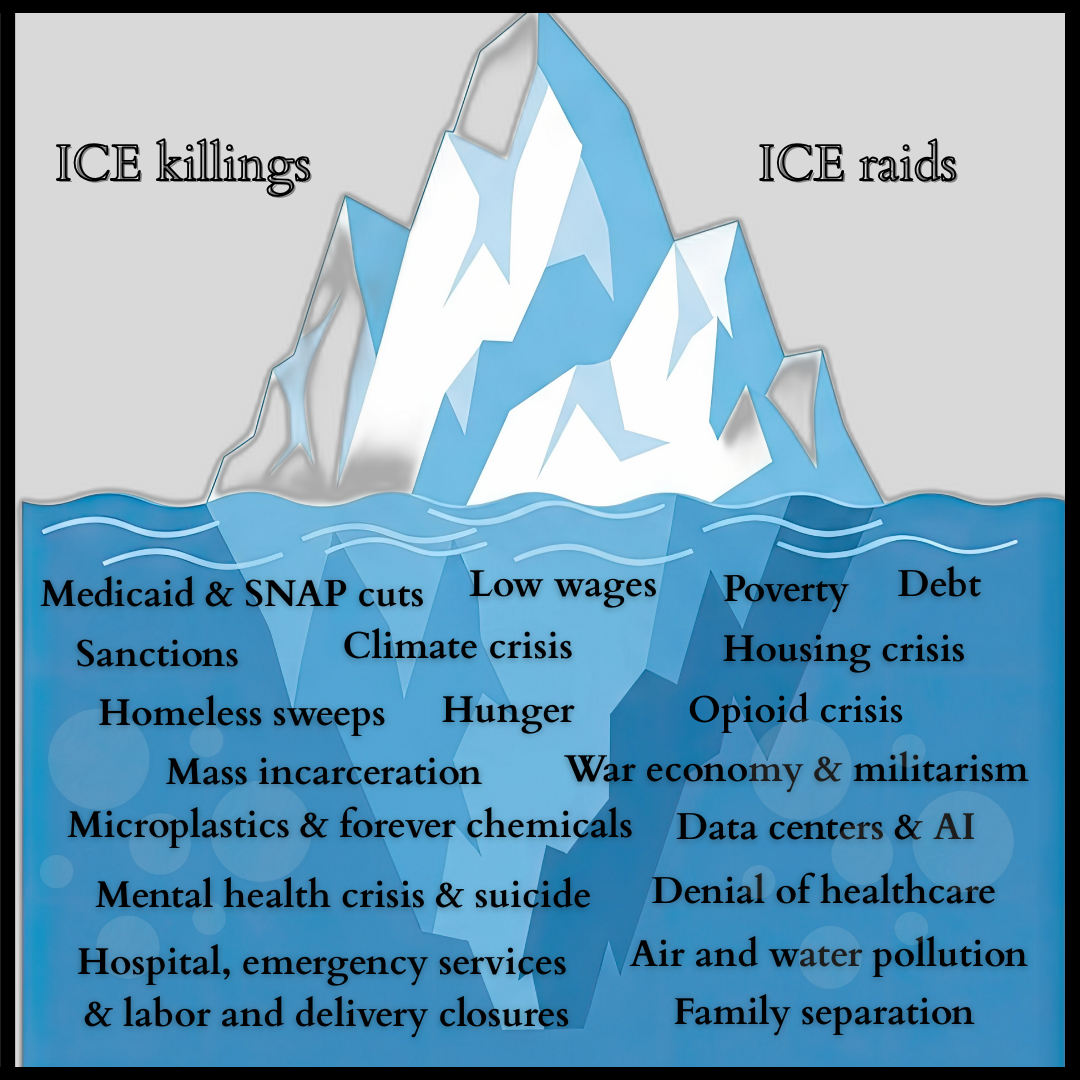
ICE killings are murder out loud. One of the most visible expressions of state violence in this time. 

We have to join the outrage about the loud murder with a deeper agitation and understanding of the quiet murder. 

Rugged individualism is embedded in everything we do – even “social justice”. 

We get trained in individualism:

  • Individual stories
  • Individual impacts
  • Individuals matter and move people

We don’t get taught to see patterns or the interconnection between things. We get trained neither to zoom out to the big picture, nor to dig deep and understand the root of the problem. We just see what is right in front of us.  

We generally aren’t moved by the mass struggle of life and death for our class. Not yet. 

Developing class consciousness means understanding that these different tentacles of the fundamental problem are not separate from each other. 

It means facing and feeling the quiet murder of letting pandemic protections expire in the Great Medicaid Purge of 2023 when 27 million people were kicked off of Medicaid leading to at least 15,000 additional deaths. 

It means facing and feeling the 73% decline in wildlife populations; and 42 million people killed by sanctions – both since 1970.

It means facing and feeling the 25-30 year reduction in the life expectancy for people who are unhoused, while 20-30 homes sit vacant for every person who doesn’t have a place to stay. 

It means facing and feeling the reality that nursing homes controlled by private equity have led to an increase of 10-15% in mortality rates, or 22,000 additional deaths over the course of 12 years.

It means facing and feeling that poverty kills 800 people every day, or 292,000 people every year in the United States.  

It means facing and feeling the reality that there are  48,000 suicides yearly, many linked to the chronic stress of living in this society. Alcohol and drug related deaths – coping behaviors – lead to 100,000 deaths yearly. The police killings of 1,000 humans and 10,000 dogs on average each year. The microplastics and forever chemicals in our bodies linked to heart disease deaths – and much more. 

All the centers of profit-making and the forces of capital are arrayed against our very lives and existence. 

These are systemic crimes, but the perpetrators of these crimes don’t get put on blast in the newspaper, they own the newspaper. And social media. And the private equity firms. And the stock market. And Silicon Valley. And our political system is the committee for managing their affairs. 

It is the millions suffering from quiet murder that will make history. Our task is to build the necessary unity, organization and understanding to assist in that process. 

Some sources:

https://www.cdc.gov/nchs/data/databriefs/db526.pdf

https://pmc.ncbi.nlm.nih.gov/articles/PMC11066981/?utm_

https://jamanetwork.com/journals/jamainternalmedicine/article-abstract/2806963

https://www.nber.org/digest/202402/estimating-mortality-rates-us-homeless-population?page=1&perPage=50

https://www.optimalhealthsystems.com/blogs/wellness/as-studies-mount-researchers-estimate-microplastics-cause-356000-heart-disease-deaths-each-year?utm_source=chatgpt.com

https://www.thelancet.com/journals/langlo/article/PIIS2214-109X(25)00189-5/fulltext

Why I Am Not A Leftist

I don’t consider myself a ‘progressive’ or a ‘leftist’. Let me explain…

First of all, where do we even get these terms? The concept of a “leftist” as associated with a certain set of ideas comes from the French Revolution. The rising national bourgeoisie sat on the left in the National Assembly. They wanted an end to feudalism and monarchy, market freedoms, certain forms of equality and private property. That revolution helped usher in the shift from feudalism to capitalism, born on the industrial revolution and a new mode of production. 

Of course the French Revolution looms large in history and set the stage for the development of working class theory. I fully understand that there a global resonance to the concept of “leftism”.  However, in the context of the United States, with its two main corporate political parties, the concept of “left” loses much of its meaning. In our context, the vast majority of “leftists” are essentially a part of the Democratic coalition by necessity (and I don’t blame them for that).

So what about “progressive”? The term can be dated back to the “Progressive Era” and the corresponding activism during the Gilded Age at the turn of the 20th century. One hundred years after the French Revolution, in the wake of the Civil War, with the slave power vanquished and Reconstruction defeated, the rapid industrialization of the second technological revolution proceeded in the United States. Robber barons, strikes and labor wars, monopolies and trusts dominated the day. Progressivism brought a push to expose injustice and promote demands for government regulation of industry. However, just as today we distinguish between the poor organizing the poor vs. the rich organizing the poor, class-conscious historians like Gabriel Kolko have shown that it was the capitalists themselves that pushed for reforms and regulation in order to preserve their class position for the long haul

So, let’s think for a moment beyond political labels. I don’t organize people on the basis of their self-described political identity. I organize the unorganized, on the basis of our position with respect to and our relationship to the economy. Which is that we don’t have an ownership interest in, a controlling interest in the economy. I organize the 140 million people who are poor or near poor, those with the most to gain and least to lose from a fundamental transformation of society. And the objectively revolutionary class comes from both the “left” and “right” on the political spectrum. 

I’m not interested in just “fighting the right’, I’m interested in fighting the billionaires and the system they uphold. The billionaire class lined up behind Biden in 2020 and behind Trump in 2024. They don’t have lasting political allegiances. They act as a class, in their class interests. But we don’t – not even (and sometimes especially) “leftists” and “progressives” because those terms become reasons to keep ½ of our class OUT. 

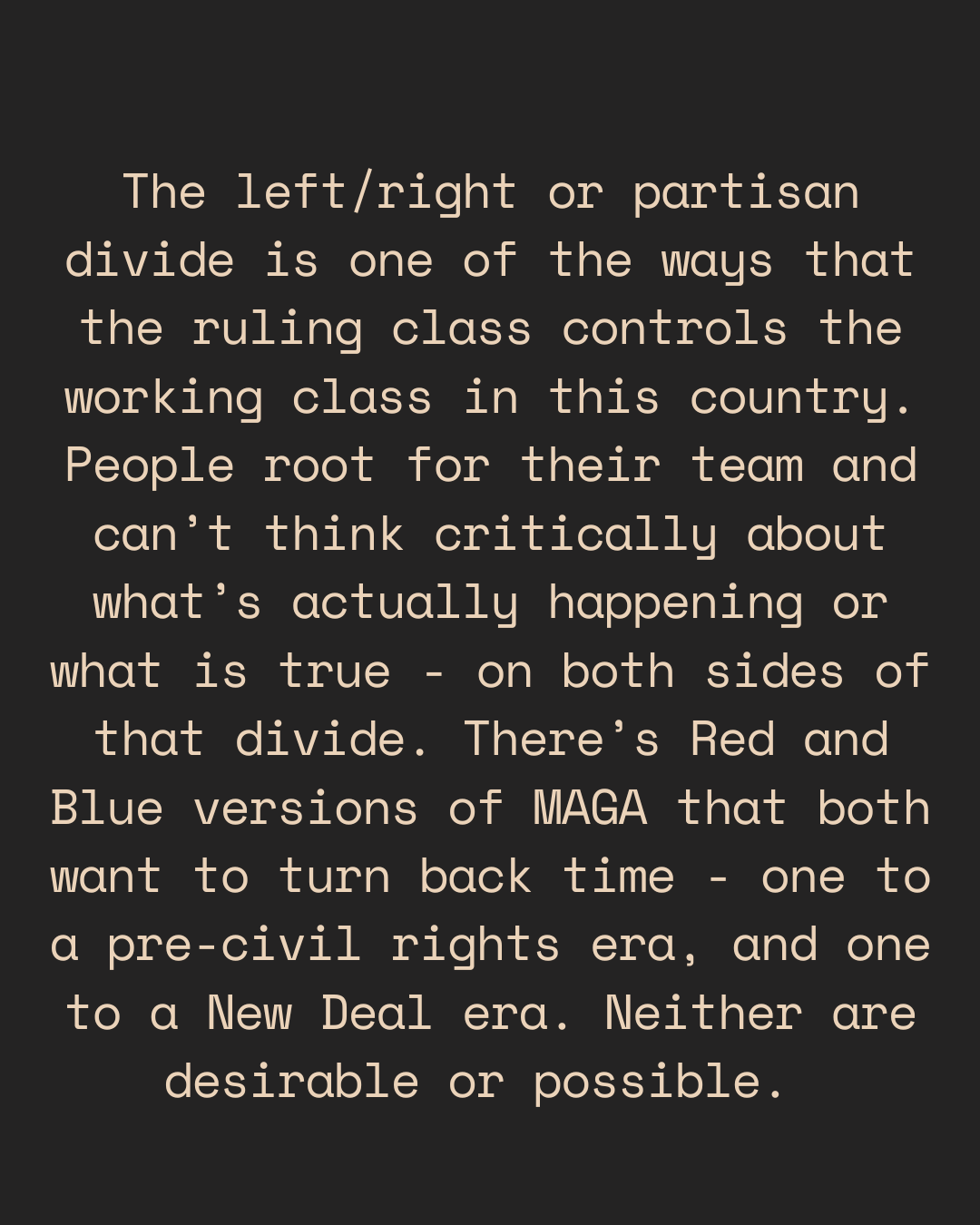
The left/right or partisan divide is one of the ways that the ruling class controls the working class in this country. People root for their team and can’t think critically about what’s actually happening or what is true – on both sides of that divide. There’s Red and Blue versions of MAGA that both want to turn back time – one to a pre-civil rights era, and one to a New Deal era. Neither are desirable or possible. 

The Republican Party in its original form emerged in the lead-up to the Civil War, as neither the Democrats or the Whigs could resolve the contradictions of the slave system. It was born in March of 1854 in the small town of Ripon, Wisconsin. One of the founders is recalled as saying “we came into the meeting Whigs, Free Soilers, and Democrats, and we came out Republicans.”

The way some of the “leftists and progressives” talk today their quote would be “we came into the meeting progressives, leftists, and ultra-leftists and we came out ….” Nah. 

The 140 million draw from every political persuasion. Many are part of the tens of millions who don’t regularly participate in the process no matter what label is associated with their voting record. 

We can either be the “left wing” church or we can be the church of the poor and dispossessed. We can either be the “left wing” veterans or we can be the veterans group that is for the poor and dispossessed. We can either be the organization focused on “turning the state blue” or we can be an organization that fights for the poor and dispossessed. As soon as we start considering ourselves the “democratic” version of what the republicans have then we are proxy soldiers in the ruling class’ game. We can be the [insert your thing here] of the Democrats or we can be poverty abolitionists engaged in a class struggle.

There are fissures happening in both parties and new forms are sure to emerge. Some of them will be imposed from above and some of them will come up from below. I’m not discouraging anyone from voting or participating in the political process, but this is about building what MLK called “the new and unsettling force”. That force that is capable of transforming this society from the bottom up is not simply found among the poor who vote Democrat. 

I’m looking to move people wherever they are on the political spectrum in a few key areas. Recognizing that their problems are not theirs alone. Helping them see below the surface of what is happening and connecting their experiences and insights to a bigger picture. Many people are ready to skip over platitudes and signifiers, and knowing all the right things to say. They want real material changes that can only come from class struggle.  

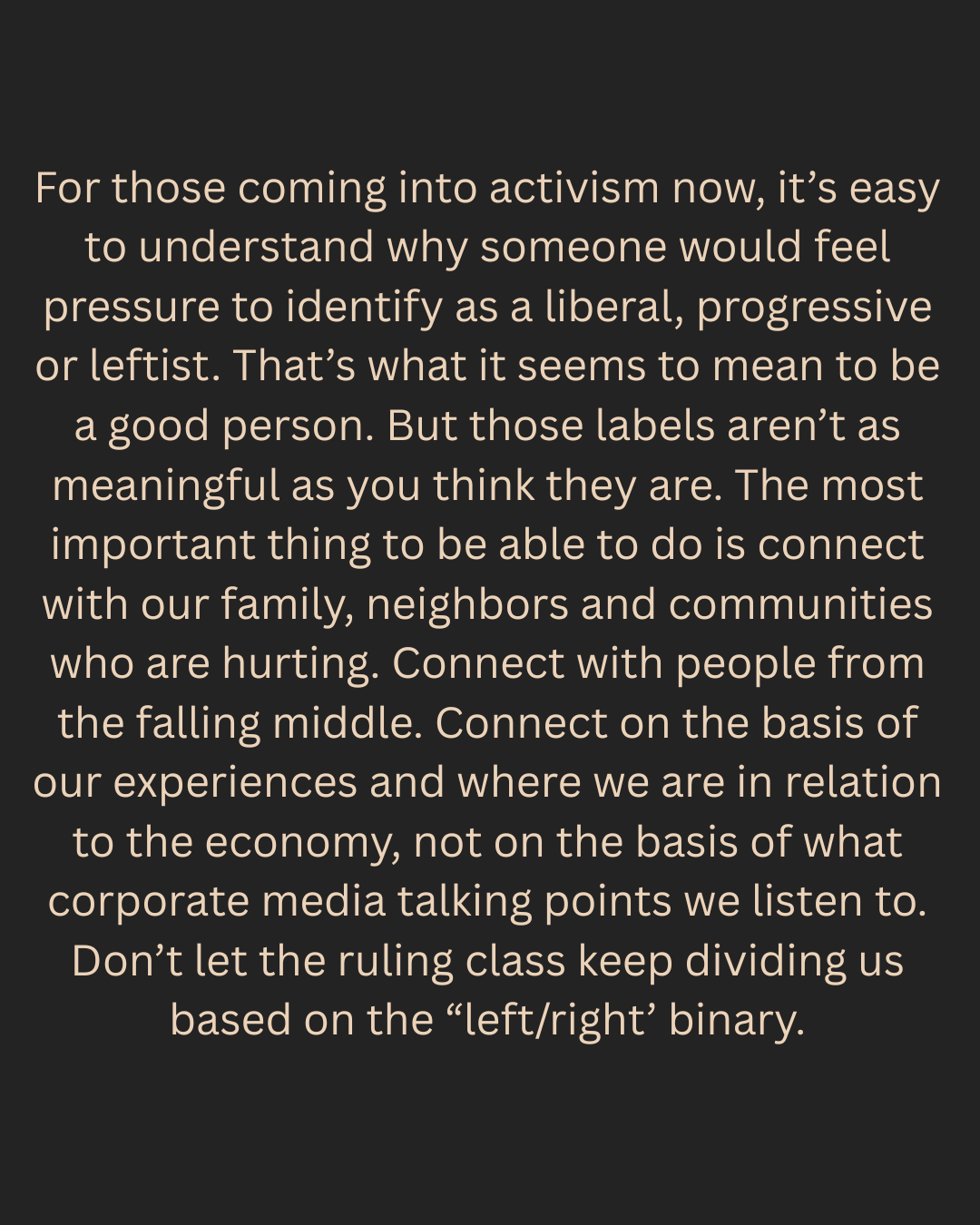
For those coming into activism now, it’s easy to understand why someone would feel pressure to identify as a liberal, progressive or leftist. That’s what it seems to mean to be a good person. But those labels aren’t as meaningful as you think they are. The most important thing to be able to do is connect with our family, neighbors and communities who are hurting. Connect with people from the falling middle. Connect on the basis of our experiences and where we are in relation to the economy, not on the basis of what corporate media talking points we listen to. Don’t let the ruling class keep dividing us based on the “left/right’ binary. 

Be part of a movement to abolish poverty. A movement that cuts across racial, geographic, and party lines. Leftism is a barrier to entry that I’m not willing to put up. I am of, by and for the working class. I’m not here to unify the left, I’m here to unify the bottom.

The Problem with the “Hands Off” Protests Is Not What You Think

First off I just want to say that this is a stressful time for almost everyone. This is not an easy period that we are living through – whether we’re accustomed to ongoing crises or we’re more recently waking up and feeling it. My heart and love goes out in solidarity to all of us who are experiencing fear, grief, anger, uncertainty, disillusionment, and many other challenging emotional states and real life consequences resulting from the crisis in the capitalist system. 

But there is “hope”, many say, as evidenced by participation in the April 5th protests around the United States, broadly cast as “anti-Trump and Musk”.

My socials are filled with folks proclaiming how “hopeful” it is to see so many people take to the streets in these symbolic protest actions. And along with that “hope” comes the withering criticism of those of us with a “critique”. 

We’re just so naive/misguided they say. “How can anyone sit there and criticize folks who are getting activated for not being “correct” or “radical” enough? We have to meet people where they are!” 

And to that – I completely and unequivocally agree! My criticism is not with the people who showed up for this rally. That would be ridiculous. We need masses of people taking action together, now and always! 

But I don’t believe that the turn-out is in and of itself a beacon of hope. It’s an indication of possibility, but it will take much more to turn that possibility into real hope. Just as faith without works is dead, hope without clear, connected, competent and committed leaders is empty. 

Do you remember, or have you ever heard or read about what happened on February 15, 2003? 6-10 million people worldwide took to the streets to protest the Second Gulf War. The largest protest in human history, according to the Guinness Book of World Records. 

Wall Street interests prevailed, the war proceeded, slaughtering 1,000,000 Iraqi people in the course of the war and its aftermath. The U.S. service members who were forced to wage this war were crushed by Gulf War Syndrome, depression, and PTSD, as well as chronic health conditions from toxic exposures.  

On November 4, 2023, the largest protest in solidarity with the Palestinian people took place around the globe, with estimates of more than half a million in the streets. The Israel-led and U.S. backed genocide rages more ferociously than ever. One child is killed every 30 minutes in Gaza. 

In the course of the summer of 2020, an estimated 26 million people participated in protests connected to the George Floyd uprising. 4,600 people were killed by the police in the U.S. during the Biden administration. White people comprise the largest number of those killed by the police, while Black people are 3 times more likely to be killed by police with figures for Indigenous people ranging from 3-7 times more likely. 

In his important book “If We Burn: The Mass Protest Decade and the Missing Revolution”, journalist and author Vincent Bevins examines the global wave of protests between 2011 and 2021, asking the critical question: Why have the upsurge of protest movements around the world not resulted in serious and lasting change?

Which brings me back to my point – what exactly is my criticism? Do I stand against “hope”? 

Of course not!

And yet, I do believe that our hope must be based in reality, not fantasy. 

Our hope must be based in each other, not the misleaders who have kept us on a treadmill of hope and despair, mobilization and demobilization, lying to us about the source of why things have gotten steadily worse across the entire working class in this country for the last 50 years. 

Our hope must be based in each other, not the party that the ruling class used to continue to degrade the position of the working class through NAFTA – the North American Free Trade Agreement (1993) which resulted in massive industrial job loss; Welfare Reform (1996) which replaced a social safety net with market-driven “workfare”; the Telecommunications Act (1996) which led to the rise of media monopolies and the age of disinformation; financial deregulation and the Gramm-Leach-Bliley Act (1999) which led to the 2007-2008 financial crisis; the Troubled Asset Relief Program (2008), or the bailout of Wall Street at the expense of the working class, and the Affordable Care Act (2010) which preserved, expanded and protected the private insurance system that profits off our sickness and death.**

These are among the policies that helped pave the way for the degradation of our living conditions such that we now count 140 million people in the ranks of the poor or those of us one healthcare or housing emergency away – nearly half the country. 

Just like we can’t expect an engine that runs on fossil fuels to belch out anything but polluted air, we can’t expect an economic and political system that runs on systemic racism, poverty, environmental devastation and militarism to produce anything but more of the same. 

So I’m here for the big tent – believe me! The tent I’m building is big enough for 140 million people – and guess what – those people are hurting – across the color line, the party line, and the urban/rural divide. I’m not here to listen to anyone speaking from the podium who says that the problem is chiefly or exclusively Trump. I don’t want to go back to the normal of 2023-2024, when 25 million people were kicked off of Medicaid in this country. We need to go forward.

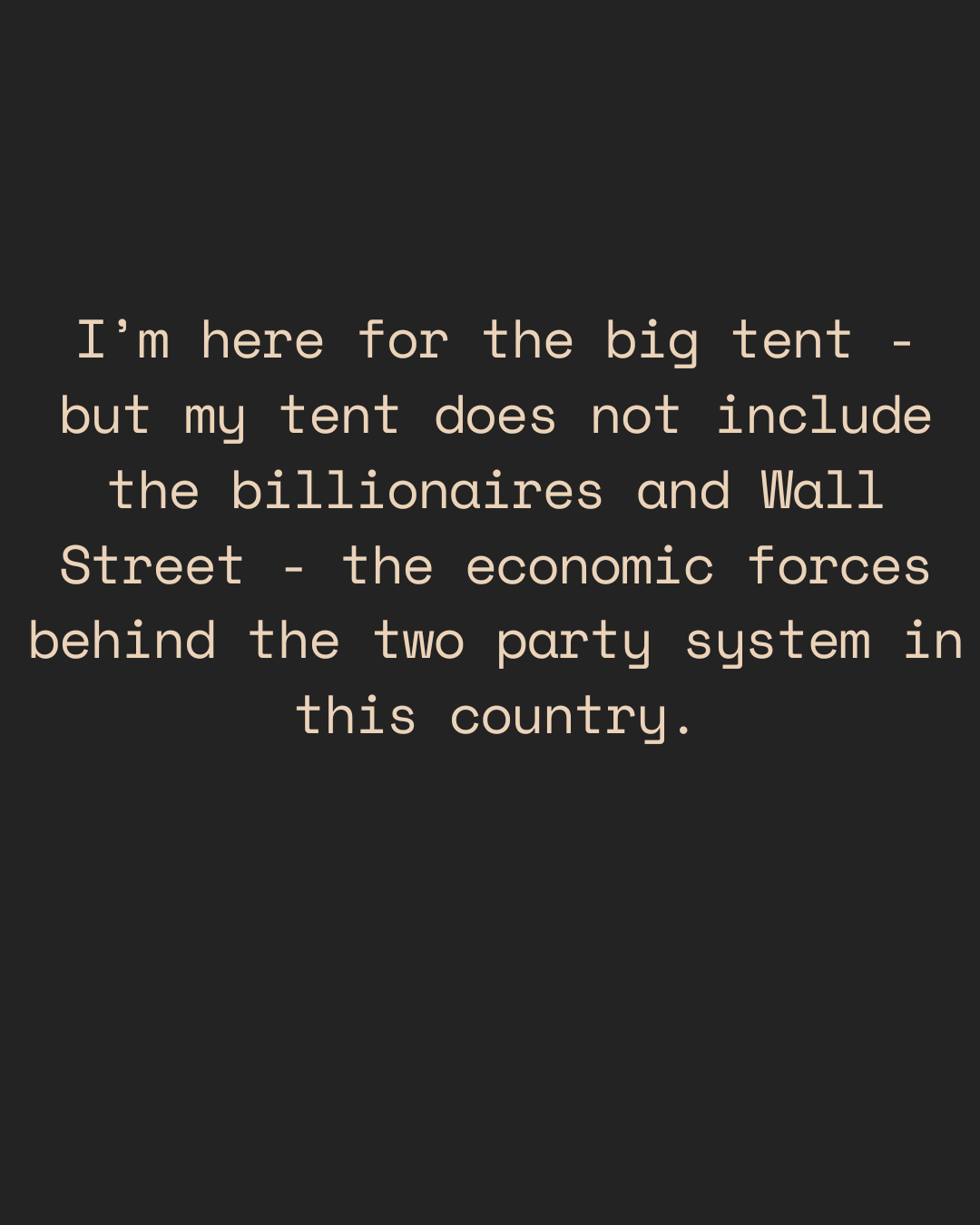
I’m here for the big tent – but my tent does not include the billionaires and Wall Street – the economic forces behind the two party system in this country. 

I’m here for the big tent – but I refuse to be operationalized and co-opted by one section of the capitalist class in order for another section to prevail. We’ve been there before – we went from the period of Reconstruction after the civil war to the backlash of the Redeemers. We went from the upsurge of independent working class organization in the wake of the Great Depression to the New Deal Coalition which saved capitalism from itself. I refuse to set the table for the capitalist class to continue to eat while we starve. 

The nationwide rallies can be hopeful IF:

The people attending and organizations turning out their members demand of the official sponsors that no politicians be allowed to speak from the podium. The primary task of these figureheads is yoking us to a hamster wheel of 1) mobilization, 2) demobilization and 3) voting for the bad or the worse because they are yoked to a system that puts profit over our lives and planet. Here’s a great example of what it means when poor folks take the stage. 

They become moments to raise class consciousness, unite across issue silos, and talk about the fundamental problem. We are not a compendium of identity groups who need “allies”. We are a diverse working class trying to survive a war being waged on us by Wall Street, whether we currently know it as such or not. We need to get together, desperately, and see our common problems. We need people from the ranks of the organized poor to grab the mic, teach the historical and economic roots of this current crisis, shift the focus away from “experts” and “VIPs” and help the poor and dispossessed to understand ourselves as the only people capable of unsettling this society and putting us on a path of transformation. Here’s a great example from the Rev. Joe Paparone in Albany, NY.

We use them to bring people into the politically independent organizations of the poor and dispossessed. Many people are ready to mobilize, but not yet ready to organize. However, we need to train thousands of leaders NOW as we prepare for much bigger eruptions and outbursts that will inevitably result from the unsustainable organization of and relationships that govern our global economy. Those upswings and outbursts will not as easily be led, co-opted, and directed by the powers that be. As we raise the consciousness of the people turning out for “Hands Off”-style demonstrations, we can immediately begin to help those who gravitate toward us to see themselves as PART of the working class, not simply the “middle class”. This is the beginning of the journey for many folks getting mobilized right now. The work of member-led, staff free networks like the National Union of the Homeless and the Nonviolent Medicaid Army point the way forward. 

Thank you for all that you do every day to put people first.

Some more helpful reading:

**[For further reflection: For those of us who voted for this party that has pursued these policies for the last 50 years – have we been voting against our own interests? Should we be held accountable – as everyday people with no property and power to speak of – for the massive social dislocations, hollowing out of our industrial base, depression of wages, culture of misinformation, out of control healthcare costs, the opioid crisis, deaths of despair? Are these things our fault for voting this way? Or were we simply making the best choice we felt we had at the time?]

How did we get here? A story.

Hold onto your beenies folks. 

Our story starts 60 years ago. The civil rights movement gave way to the Watts uprising in 1965. The Watts uprising shook the foundational assumptions of the civil rights movement and called into question its gains.

Let’s revisit what MLK said to musician, actor and activist Harry Belafonte, shortly before his (MLK’s) assassination: “I have come upon something that disturbs me deeply. I’ve come to believe we’re integrating into a burning house. I’m afraid America may be losing what moral vision she had. Until we assure the underclass has justice and opportunity, we will continue to perpetuate the anger and violence that tears at the soul of this nation.”

And at the Mason Temple in Memphis Tennessee on April 3, 1968, speaking to striking sanitation workers the day before he was assassinated [chills] King said “What good is having the right to sit at a lunch counter if you can’t afford to buy a hamburger?”

What King is speaking to here is the failure to resolve the problems of the “underclass” – which in King’s time he counted as 40 million and which today constitutes the 140 million people in the United States that are poor or near-poor. It was the poor and dispossessed that rose up during the Watts Uprising, not the Black petite-bourgeoisie of nearby Baldwin Hills. The co-optation and diversion of the civil rights movement by the powers that be paved the way for a comparatively small segment of Black people to ascend into higher echelons of the state and the public and private sectors.  The contradictions of the class structure in the United States remained unresolved. 

Address Delivered at the National Conference on New Politics August 31, 1967
Source: Poor People’s Campaign: A National Call for Moral Revival

Let’s let MLK bridge us into another piece of context for how we’ve gotten here today. The automation of the 3rd Industrial Revolution – the invention of the microchip and the adoption of computerization across the economic system resulting in the ability to offshore/outsource production and create global supply chains.

From a presentation on the economic crisis by Chris Caruso

The third industrial revolution began to displace large numbers of workers and heralded the shift from an industrial workforce to a service economy. At the same time, as a consequence of this increasing automation, the ruling class rolled back social welfare programs. Not as many workers needed = not as much support needed to keep workers alive. Less incentive on the part of the capitalist class for social investment into workers’ healthcare, housing, education and overall well-being. Remember, the capitalist class sees our class (their labor force) as a cost of production. Therefore, the retrenchment of the state and social programs. Therefore –


In the shadow of the 3rd Industrial Revolution, computerization, the shift from an industrial economy to a service economy, and the retrenchment of social welfare programs we get (drum roll please) NONPROFITS TO THE RESCUE!!! Now, the nonprofit sector is varied and includes everything from the United Way and the American Cancer Society to PETA and other things. I’m going to focus here on the “social justice” side of nonprofits. These are the organizations that get funded by the wealthy to make change in society (as long as that change does not involve taking the wealthy out of power and reorganizing society in the interests of the poor and dispossessed). A lot of great work has been produced about the nonprofit industrial complex.

I want to summarize some fundamentals as someone who has been part of, adjacent to and working in and around this sector for about 20 years now. And this is not to completely foreclose on the possibility of real potential human and material resources coming out of these formations. However, how we’ve gotten to this place in our “resistance” is important to understand.

Here are 3 foundations of the social justice sector of the Nonprofit Industrial Complex:

  1. The right way to make our society more “just and fair” is for each identity group to fight for its own version of diversity, equity and inclusion. Each group has a unique set of interests that it needs to fight for on its own. 
  2. Creating [insert identity group]-ONLY spaces is what leads to people feeling “safe” and “comfortable” and is the right way to organize. People would be “harmed” by having to be around others who are not part of their identity group. 
  3. The backdrop of the blood-soaked, ill-gotten gains of the ruling elite is white washed through this process and they co-opt an entire layer of BIPOC “leaders” from the working class who rep them. (Conservative billionaires = bad, liberal billionaires = good) even though both sets are bound and determined to keep this dumpster fire capitalist system going for as long as they possibly can. This is not the same as rich people throwing their lot in with the working class – quite the opposite. 

So here’s what we’re left with:

  1. Class struggle has taken a back seat. The entire “social justice sector” precludes class struggle because it compartmentalizes each grouping of people (largely on the basis of race, ethnicity, sexuality, age, gender, gender identity, immigration status and ability) and pretends that “liberation” is possible for each of these groups independent of a struggle to take the ruling class out of power which is necessarily a CLASS struggle.
  2. The cornerstone of the ruling class’ strategy is divide and conquer. The “social justice” sector plays right into the ruling class’ hands (being as its owned and controlled by ruling class resources and strategists). There’s no way that the liberation of any specific group can take place in the context of a society based on exploitation that is well underway to structural unemployment heralded by the 4th Industrial Revolution we are living through today.
  3. Demands for human rights are summarily dismissed as being “not specific enough”. There’s an accepted maxim that “people of color and marginalized people have always been thrown under the bus when we try to work in coalition” but that’s largely based on what W.E.B. Dubois called “the propaganda of history”. Numerous examples like Reconstruction, the Southern Tenant Farmers Union, The Bonus Army, The Original Rainbow Coalition, the Original Poor People’s Campaign, National Welfare Rights Organizing, labor history and others provide a blueprint for how our ancestors came together across the color line and changed what was politically possible. The false propaganda of history is devoured by these loyal opposition forces who largely take their cues from the academy (particularly elite institutions) and then regurgitate it to train up new generations of miseducated yet often well-meaning leaders and organizers. 
  4. White people are written off as un-organizable, not worthy of being organized, reactionary, backward, etc. Because of a faulty, flawed and idealistic understanding of reality, the assumption is either that “all white people are rich” or “no white people have a stake in changing society because they have privilege and benefit from the way things are”. This is bullshit. All this line of thinking has done is pave the way for the ruling class to develop the kind of politics of resentment that got Donald Trump elected and keeps the working class deeply divided. If people don’t see themselves in your picture of reality they will find another story to believe in. Remember the 66 million poor white people from the graphic above?

We don’t have to wonder how we got here. One of the reasons we got here is because “friends like these” are actually operating at the behest of our enemies, whether they know it or not. Many don’t know, but some certainly do. Many people are asking questions and looking for answers at this critical time. Welcome those who are.

5 confusions to leave behind as we enter 2025

The capitalists are in crisis. There hasn’t been this level of polarization within the capitalist class since the civil war. When the capitalists get the sniffles, we get long Covid. Their infighting will result in the increasing polarization of the working class as long as we are weaponized against each other instead of them. However, those who are clear on the true face of state power, which is that the state is a tool of the class that rules, can avoid being pitted against each other and instead build a movement to end poverty led by the poor – the only possible solution to the “polycrisis” bed that the capitalists have made. Faith in every single institution is breaking down – because those institutions have brought humanity to perpetual war and ecological collapse. We, the 140 million who are poor or near poor, don’t need pity, or charity. We need to know that we are the people who can find a way out of this mess because we are the first to wake up. The position of the poor and homeless today is the position of the so-called “middle class” tomorrow. We are at the forefront of understanding that there is no “going back” – any narrative that invokes the idea that we can go back (whether to the New Deal or to the post WWII “American Dream era”) is false. We must move forward, using all of the productive capacity of humanity to end poverty for all – everywhere. This is now possible for the first time in human history, and it’s about 3,000 billionaires up against the interests of 8 billion of us.

  1. Fascism is a cruel right-wing break with the existing social, political and economic order. FALSE
    • The F word is going to be all the rage in 2025 and certainly for the next 4 years. But remember, we live in an anti-intellectual and ahistorical culture where the working class is purposefully miseducated. Let’s not throw this word around while misunderstanding its history and what it really means.
    • Fascism can be described as an “open terrorist dictatorship of finance capital”. It is not the exclusive territory of one of the parties of Wall Street or the other. It is not embodied in a single person. It is an outgrowth of capitalist democracy in decay. It’s a solution for the crisis of the capitalist class when their version of limited “democracy” for the rest of us is inadequate to ensure their profit-making. Don’t perpetuate distracting falsehoods about fascism. Fascism and Social Revolution by R. Palme Dutt is a highly recommended work on this topic.
  2. The working class has nothing to complain about – everything is fine! FALSE
  • Please don’t share memes about how great the stock market is, or how busy stores are, to reinforce ruling class narratives that the working class is doing okay and has nothing to complain about. Wages have been practically stagnant for the last 50 years. We are mad, and we should be! Fighting mad – not at other workers – from anywhere in the world, but at a system that controls our lives and labor and then denies us all the basic necessities of life, because our wages aren’t enough to buy them. That’s why 800 people are dying every day from poverty in the richest country that’s ever existed in the history of the world.

So with that being said, anyone who is part of or who wants freedom for the working class should JUST SAY NO to things like this:

Victim-blaming much? Seriously stop with the Stockholm Syndrome.

3. Well, it’s all fine and good to talk about ending poverty, but to meet everyone’s needs or bring the entire world to a decent standard of living we would need additional planets, or there will be total ecological collapse. It’s just not possible! FALSE

  • The world that global capital has made is one in which technological capability and productive capacity is not used to meet human needs, but to produce unlimited commodities for the market. This anarchistic production for unlimited drive for profit results in war and devastation for people and the planet. The technology and productive capacity we have today is the result of the creative genius of hundreds of years of working class labor and millions of workers all over the world who deserve our undying love and respect. Yet, because the working class doesn’t own and control what we’ve produced, its used to emiserate and kill us. This excellent research shows that economics planned around human needs would drastically reduce unnecessary over-production and production for commodity exchange. Living standards can be raised for all people when we leave behind the insanity of anarchic production for profit.

4. Okay, but after all there is a Global North and Global South and poverty in the US is nothing like poverty elsewhere. Our role is simply to be “allies”. FALSE

  • As Jae Hubay of the Ohio Nonviolent Medicaid Army has brilliantly shown in these visualizations, the poor of the U.S. are much closer in position to the global poor than to the billionaire class that is holding the planet hostage.
Comparing the global poverty measure to the U.S. poverty threshold to Bill Gates’ daily income
Visualizing this in distance, starting from the Wall Street golden bull in New York City a person living on the daily income of the global poverty measure can get about a foot away from the bull. A U.S. person living in poverty can get across Broadway.
A billionaire can get all the way to the Bean in Chicago. We’re much closer than we’re taught to think. Workers of the world unite. We have nothing to lose but our chains.

5. But with this new administration coming in, I can’t even! Life is over. We’re about to face never-before-seen attacks. FALSE

The attacks that we’re about to see are a CONTINUATION of the war on the poor that has been intensifying over the last 50 years and has reached new heights in the “Great Recession” of 2008 and since the Covid 19 pandemic. Since April 1, 2023, more than 25 million Americans have lost their healthcare. The Supreme Court has now made it legal to criminalize us for not being able to afford housing. Deportations under Biden just last year surpassed those during Trump’s first term in office. Don’t fall into the trap of being weaponized against other working class people because of the polarization in the ruling class.

I could go on… I thought about adding a 6 or 7 but 5 is a good number for now. Bonus confusion to leave behind is that acts of individuals are enough to save the day. They are not. The ruling class has the power of the “pen (media), the purse (money) and the sword (military)” to quote Frederick Douglass. What we have is our numbers, and our numbers mean little without organization. Organization requires “intelligent and unselfish leadership” (W.E.B. Dubois). And leaders must be clear, committed, competent and connected. (Willie Baptist). So let’s get clear and let’s get organized!!

** Top image is unsold Tesla inventory, visible from space.

Nijmie 101: Get to know me

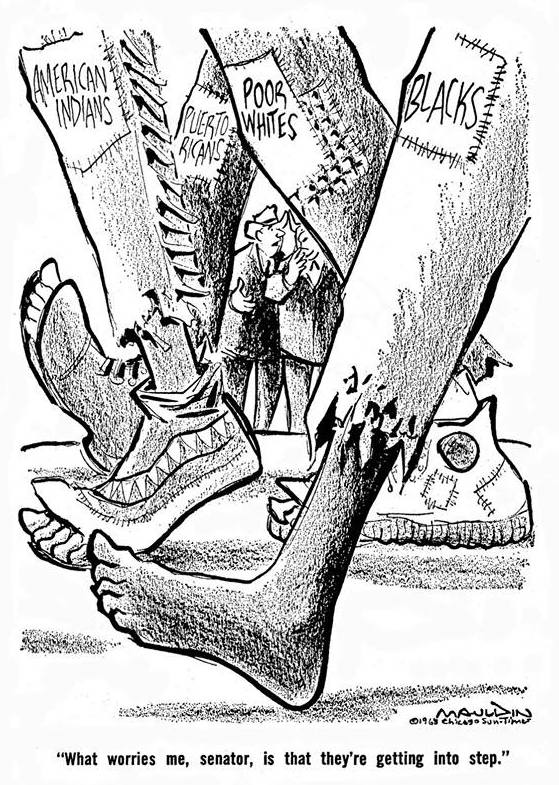
1968Cartoon_GettingIntoStep


Here are some snapshots from my organizing over the years in terms of some of the issues and campaigns that I’ve worked on, and the trajectory of my political orientation and theory of change.


Poor People’s Campaign: A National Call for Moral Revival

A New Poor People’s Campaign on the Dig (audio)

History of the Poverty Initiative (Kairos Center -) one of the two national co-convening organizations of the Poor People’s Campaign

Ending Poverty: Immersion in the Mississippi Delta (article)

Katrina: Poverty, Race and Ethics (article)

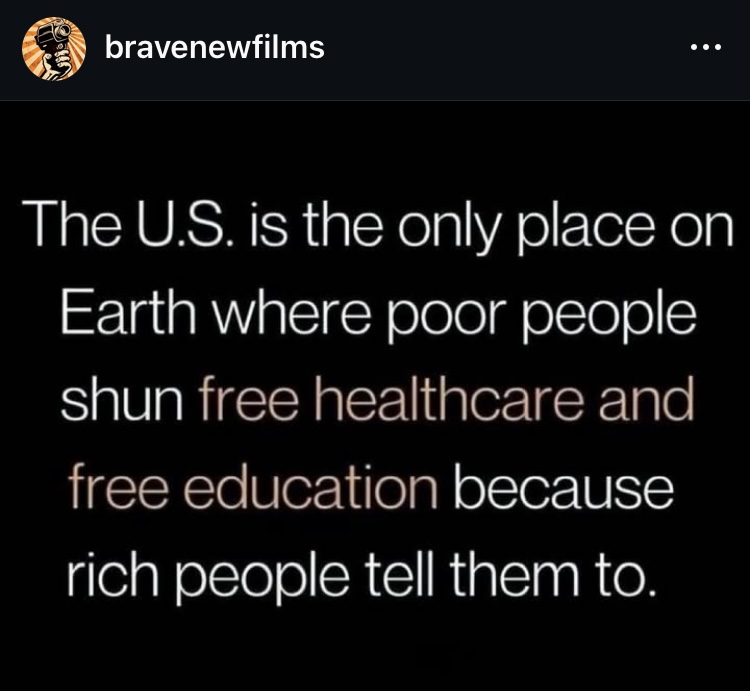
Healthcare is a Human Right

On building a diverse working class movement on the Dig (audio)

The Strategic Significance of Healthcare as a Human Right with Sarah Jaffe (article)

Revolutionary Common Sense on Hack the Union (video)

Education is a Human Right

Campaign for Nonviolent Schools (article)

https://mediamobilizing.org/mmptv-episode-6-no-education-no-life-preview/

Housing is a Human Right

Supporting the Community Leadership Institute in Philadelphia (article)

Community Preservation Network (article)

International Human Rights

International Women’s Peace Service (article)

The Landless Workers Movement in Brazil (MST) (article)

Co-founder: 

Media Mobilizing Project

Put People First! PA

Restarted and Former Executive Director

Philadelphia Student Union

How to keep the political revolution going in PA

12439044_1080228402008623_1042554473714263778_n

When I posted this on Facebook the morning after the PA primary. . . .

“Bernie Sanders won 30 counties in PA. Primarily the rural counties. The counties people disdain as “Pennsyltucky”. The counties young people move out of because there is no work. The ones most people in Philly or Pittsburgh have never heard of. They may not identify as liberal or progressive. They do not use the phrase “white supremacist capitalist hetero-patriarchy” on a regular basis. Yet they voted for a platform of breaking up big banks, making healthcare a public good, and free higher education. Is that sinking in? They understand that everything that Wall Street has is ours because Wall Street owns us, it owns the people we elect; and all of our taxes, rent, fines, interest, fees, energy, water, land, and bodies go in service to it. They can see it even more clearly than a lot of us in Philly. The places that capital has abandoned are the ones where something else is taking root.”

I had no idea it would resonate so much with people here in PA and around the country, with over 600 likes and 274 shares.

I think for many folks it was an interesting twist on what they initially felt as a disappointing election result. So I wanted to follow up and share some strategy thoughts for people who want to continue on with making an actual political revolution here in PA, that outlasts any one election cycle. These thoughts are based on 25 years of history and current experience with people’s struggles, which I have been involved in since the age of 14.

We need permanently organized communities. That means we need everyday leaders who live near each other and who are connected to each other and committed for the long haul. These cores of leaders then must be connected to other cores locally, regionally, statewide and beyond. Building the power to make the kinds of changes that we need to put people before profits is not going to happen overnight. Mobilizing even large groups of people to one or multiple actions is insufficient to the task of shifting power in society.

We have an unprecedented opportunity to unite poor and dispossessed people across racial lines and all other lines of division; and we need to understand racism and gender oppression One of the most interesting things about my FB post is that although I was critiquing the kind of politics that privileges language learned in elite educational spaces over material conditions and lived experiences, the phrase “white supremacist capitalist hetero-patriarchy” was nevertheless shared hundreds of times. Which is not a bad thing. We who believe in freedom need to understand that the range of different ways poor and dispossessed people experience day to day life in our system are a living legacy of the harmful divide and conquer strategies that began on this land in the 17th century and continued to evolve at the hands of elites from there.

A critical mass of people is rejecting the idea that poverty is a moral failing and realizing that our system itself reproduces poverty. There is tremendous power in finally ridding ourselves of the pox of shame and humiliation that comes with not being able to meet our basic needs whether that’s a new experience or not.

The left/liberal and right/conservative boxes are killing us. At the ground level, the two major political parties use poor and working people at the ballot box and then largely abandon us when the vote is over because they do not actually represent our interests. Spending all of our time faux-fighting people on the “left” or on the “right” is a distraction from understanding that our world is much more oriented toward “top” and “bottom”. We need independent politics.

Study and education are crucial.We have a tendency in our culture to leap before we look and shoot before we aim. We rush into trying to change things before we understand what’s been done before, and what lessons have been learned. If we are serious, not just playing around or tinkering around the edges, then we know what an awesome responsibility it is to try to change the course of history. Would you trust that responsibility to someone who knows nothing of history?

Transforming human relationships through practice. Our society is currently set up to keep people who are dealing with a lot of the same problems in isolation from each other. Not to mention that we have a long history of segregation along lines of “race” and color, we speak different languages, and we have different customs and cultures. Yet we have to manage to get together, not at some fictional point in the future, but as soon as possible. And working together, being together, creating strategy together and taking collective action, is not simple given how fractured we are. It has to be a conscious leadership practice that brings marginalized people into the center, cultivates deep trust and relationship, and helps expand each of our individual circles of concern beyond our immediate family or people who look like us.

For more information on organizations working to be vehicles for these kinds of practices and approaches see:
Put People First! PA
A New Poor People’s Campaign for Today

10687533_923993334292360_3577040018194364090_o

Refuge, Reason and Resolve

My mother's grandparents, immigrants from the Levant

Pictured: My mother’s maternal grandparents, immigrants from the Levant (at the time known as “Greater Syria” including what is now Syria, Lebanon, Jordan, and Palestine/Israel), pre WWI

There is a petition circulating right now in Pennsylvania asking Governor Wolf to reject Syrian refugees. Over 70,000 people have signed it. One of the most frequent reasons petition signers give for their position is that there are hundreds of thousands, millions even, of people in our state who are suffering, and who don’t have what we need. If you signed this petition you may have real concerns about your neighbors, friends and even family members who are trying to make ends meet and dealing with unemployment or underemployment, challenges around housing, healthcare, education or childcare, or caught up in the system in some way.

And you’re right that there are altogether too many people here in Pennsylvania who are struggling. One fifth of our children are living in poverty. We have over 15,000 homeless people, and 50,000 thousand people locked in cages due to mass incarceration. The number of our homeless veterans increased by nearly 50% in the last six years. Nearly one and a half million Pennsylvanians live in poverty. That’s over 1 million/10% of whites and 28.7%/370 thousand African-Americans. A full-time, full-year minimum wage worker earns $15,080 annually, an amount still below the poverty line for a family of four.

However, we have to ask ourselves, are the Syrian refugees the source of these problems? Will not admitting refugees fleeing war and poverty solve the problems that we as poor and working people have in Pennsylvania? Will refusing refugees help homeless veterans? Will it house those who need housing? Will it provide medical care to those who need it? Will it feed the people who need fed? Will it educate the students who need education?

Not only will refusing refugees fail to make any of these situations better, it also won’t create more resources for any of these things – because as we can see, we are already don’t have them. The only way to get what we need is to stop blaming each other and come together. By doing this, we can begin to understand how we got here and what we need to do to change it. We only get what we are organized to take and we aren’t asking for anything but the basics that we need to live. You are right to sense that the priorities of the powers and principalities are not working in your interests. But the refugees are not to blame.

Let us not allow ourselves to be motivated by fear. Let us now allow ourselves to be motivated by despair. Let us not be fooled into thinking that there isn’t enough to go around. Love knows no boundaries and no borders. Let us feel and be motivated by love. And in doing so work for a world in which the last, whomever and wherever they are, shall be first.

Discussion Questions:

Pennsylvania has a flat tax system meaning that whether your family makes $15,000 or $15,000,000 dollars, we are all taxed at the same rate. Do you think that is fair? Why or why not?

Has anyone in your family/anyone you know ever held a job that hurt/polluted themselves, other people, or the air, land, and water? How do you feel about the choices that we have to make to survive?

What is the history of your family? How did your ancestors come to be in the US? Were they brought here by force as enslaved people? Were they immigrants? Refugees? Are they Indigenous people?

Have you or someone in your family gone to war? How did it impact you/them? What were the stated reasons for the war? What were the real reasons?

Sources and further reading:
http://www.pennlive.com/editorials/index.ssf/2010/03/living_below_poverty_in_pennsy.html
http://www.spotlightonpoverty.org/map-detail.aspx?state=Pennsylvania
http://www.newsworks.org/index.php/local/philadelphia/62343-despite-national-trend-more-veterans-homeless-in-pennsylvania

My Own Private Vigilante

PSU members and me, 2008It was the spring of 2007 and  my students were amped about the US social forum in Atlanta.  I was the Executive Director of the Philadelphia Student Union and also organizing at Sayre High School in West Philadelphia. My students were so excited and I committed to taking a group of about a dozen students to Atlanta, and then had to set about figuring out how to do that logistically and monetarily.

What began with those students resulted in PSU effectively organizing the bus from Philly to Atlanta for the whole city that would enable us to go. We had to figure out everything and transportation, food and accommodations for all the students and staff members that came along was not easy.

Through some friends I was able to secure housing for all of us in an apartment complex where the residents were going to be away during the time of the forum.  We got in to Atlanta, had to carry our bags to the restaurant where the person with our key was, then truck out to the where we were staying.

It was a trying trip.  A dizzying array of workshops and activities; the Georgia summer heat; I believe I was approached by some kind of undercover agent who started questioning me about Philly groups and people (strange because at the time I was not wearing a social forum badge); and a notebook of mine went missing.  Being right in downtown Atlanta meant that my students’ attention was constantly drawn to the kaleidoscope of tricked out cars with rims, hydraulics, and candy coated gloss constantly riding by on the strip.

One of my student’s birthdays fell during the forum and we got him a cake to celebrate. We were all back at the apartment around midnight, singing happy birthday (quietly I remember, because we were being thoughtful about how late it was) when I heard a knock on the apartment door.  I thought at first that one of the students was pranking me when I looked through the peephole and saw no one there.  I opened the door, looked outside and to my shock saw an armed white male in plain clothes off to the left of the doorframe with his arms extended.  In his hands was a gun pointed toward the ground like you see when cops are getting ready to barge into a situation, and his finger was on the trigger.

I immediately closed the door to put a barrier between him and the young people.  I was thinking about the students circled in the living room on the other side of the door, eating cake and laughing and how I had a duty to protect them and would do so at any and all cost.  Thinking about my body language and tone and not wanting to escalate the situation I began to engage him.  I wanted to be calm yet extremely firm.  “What is going on?” “You can’t be here right now,” he said. I explained that we had permission from the residents of the apartment to use their space for the week.  He said, “This is a private apartment complex and you are not allowed to have so many people staying here.”

We went back and forth for a couple of minutes during which time he put away his gun.  I remained insistent that we were within our rights to be staying in the apartment and made it clear that under no circumstances was he coming inside.   When I asked why he was profiling us he said that someone who lives in the complex had called him.  I think that I remember him saying that he was an off-duty cop.  He ended by telling me that the residents would get a citation and possibly get evicted for having us stay in the apartment.

After he left, I went back into the apartment, shocked and numbed.  I had to tell the young people that a man with a gun had just been standing right on the other side of our front door.  I told them what had happened, that presumably, someone or several people from the apartment complex had called this off-duty cop/vigilante on us because they felt that “we didn’t belong there”, and he took it upon himself to come over and check out what was going on.

I was so angry and made no effort to hide this from the students.  We had to come up with a plan, some kind of response.  After checking in for a few minutes, we decided to go outside.  If they think we don’t belong here, we should show ourselves to them, to contest their cowardly actions, right here right now.  We’re going to show them that we’re not afraid.  So the 12 or so of us, went outside, and stood there.  There was a light rain coming down and it was after midnight, but we stood there, daring the people watching us from inside their apartments between their blinds to come out themselves and meet us, or do something else about it.  But we weren’t going away.

I was angry about the whole situation. I was angry that we had been referred to stay in a place where that would happen to us.  I was angry that the folks who rented the apartment didn’t warn us or give us any concept of what the people living there were like.  I was angry that a vigilante came to our door and came within feet of my students with a fucking gun!

There is no doubt in my mind that we were profiled because of the racial fears of the folks in the apartment building on seeing a group of Black youth in “their” space.  The thing that makes me the angriest and saddest is that not one of those people who were looking at us, watching us, made the effort to introduce themselves or to talk to us and ask us directly what we were doing there. Instead, they called on an armed man to intervene for them.

I’m glad that I was there physically in between the vigilante and my students.  In my (to some) racially ambiguous skin perhaps I was able to elicit a different reaction from this man than if someone else had been at the door.  There is no neat and tidy ending to this story, only an ongoing fierce commitment to act every day on the conviction that #blacklifematters and to consciously dismantle the barriers that keep us from being able to see each other as full human beings.