Considerations for Building A Statewide Movement in Pennsylvania – Nijmie Zakkiyyah Dzurinko
Who’s important?
Who’s important in Pennsylvania? Where is it important to build? Prevailing wisdom among liberal and progressive organizing in the state marks off a handful of counties that “matter”, that are “worth being in”. These are counties in the Southeast part of the state (Philadelphia and the collar counties – Bucks, Chester, Delaware, Montgomery), the Lehigh Valley (Allentown, Lehigh, and sometimes Berks), Allegheny County (where Pittsburgh is) and sometimes York and Dauphin are thrown in for good measure. The significance of these counties is that they are where population is growing as opposed to declining. They have the most people of color, and people in the “new American majority” (people of color, women, youth, immigrants). Therefore, other regions of the state (older, whiter) are not as important. The implication is that they are not the “most directly impacted”. However, if you scratch beneath the surface of this framework what you will see is that it is thinly veiled partisan politicking. It’s simply a matter of who are the most reliable voters for either major political party. Therefore, liberal and progressive groups which are most interested in shoring up votes for Democrats will focus on particular areas and cut their losses elsewhere. Same for the Republican party.
But where is the most strategic for us to focus? Do we base our calculations in the same way that the Democratic party does? I assert that to do so is our peril and renders us obsolete as an independent political force in Pennsylvania. For us, there is no Philadelphia without Fayette County. There is no center of capital without so many peripheries. And there are no centers of capital without peripheries inside of them. It’s essential to understand the relationship between the center and the periphery, without becoming distracted and satisfied with the surface level of things.
The surface level says: more people, more happening (more capital), good. Less people, less happening (less capital), bad. This is the frame that the powers that be have given us. The reality is that every locality in the state has to compete with every other locality, for tax revenue, for investment, for jobs. We cannot fall victim to the illusions of “good” and “bad” places, “good” and “bad” people which map so neatly onto places where there is capital, ie “value”. There can be no real leadership of people that doesn’t understand this fundamental dynamic. So who is important to us? How do we decide who’s important if not by virtue of categories that others use? We decide that the poor and dispossessed are important – of every color, every background, every gender, every age, every religion, every ability, every political persuasion. We unite with them, we ally with them, we go to where they are. We unite them.
Organize all manner of people
The terrain on which we are living is oppressive and it has real material consequences in people’s lives. We all carry the burden of the internalization of the ideologies that accompany and reinforce that oppression. One of the distortions of our time is the belief that you can equate one statement with a fundamental truth about who someone is. This is a false position and an elitist one. By virtue of educational and/or class privilege, some have gone through lots of training in speaking and writing. Our leaders and strategists must be able to distinguish between appearance and reality. Does a sentence or phrase that comes out the wrong way cancel out a lifetime of material struggle? Does it cancel out the sum total of someone’s experiences? Is it an exercise in the same level of power as a Governor who knowingly pollutes the water supply of tens of thousands, or capitalists and elected officials who conspire together to remake a neighborhood or a town as a playground for the rich? Why then do we feel justified to consistently react with even more outrage to verbal incidents from people with little or no structural power?
Should we be vetting the people that we’re organizing according to their language? Absolutely not. It is only relationally that we can influence them. We have to create our own language and our own approach to dealing with oppression. We’re not throwing out poor and dispossessed people – of all backgrounds – because they carry isms and phobias. There are plenty of people who can pick up those habits and wear them like clothing but they are not part of their core identity. They can take them off when something better comes along that gives them solidarity to replace it with. We’ve seen that shift happen. We want a society without police and prisons yet we criminalize and symbolically lock up people and throw away the key because of their language. We deem them unworthy, we banish them. And some of them are some of the kindest and most loyal friends you could ever imagine. There are some downright horrible people with “good” or “great” politics. They know everything about gender pronouns, they would never say “all lives matter”, they know what’s current, they know what you’re supposed to know when you’re in the know. They are in the very middle of the echo chamber of “progressives”. Yet they act horribly. They’re backstabbers. They’ll throw you under the bus at a moment’s notice. They don’t listen. They don’t even care. They just know the right things to say. This is not the basis on which to organize people or the basis on which to build a movement.
Visible and invisible violence
There is a power and hegemonic form of violence that has become normalized. It doesn’t always bleed or make news headlines, but it’s the violence baked into the way that we live every day, that we rarely ever face, because it might be too much to do so. There is violence being done to us, and the invisibilized violence we participate in just by virtue of being part of the system that we live in. We, the “good people”, the social justice “activists”, the “organizers”, we do no harm, right? We’re not like the “other people”. But the simple fact of it is, the global economic system that we are living in ensures that there is blood on absolutely everyone’s hands. There is no escaping it. There is no denying it. We get together to do the most radical of radical visioning at a conference paid for by a funder whose ill gotten gains are based on hundreds of years of oppression and exploitation. We are in a setting where workers are forced to work more and more quickly to get rooms cleaned up. They develop health conditions from picking up mattresses, fixing beds and picking things up off the floor in record speed. This is happening all around us, but we can’t even see it because we have tunnel vision. Because we’re “good”. The invisibilized violence of everyday work, of not having access to your basic needs, of waiting at the health center for six hours to be seen, of working without the proper safety equipment, of the quiet expectation of our bodies breaking down before their time, and acceptance of that. That is the horror and the hell of the violence of this system – and only one example. The violence that is normalized, and accepted. Don’t be fooled into thinking that only the most visible forms of violence are the most damaging to our people, or that anyone can claim moral superiority in this system.
Coordination is leadership
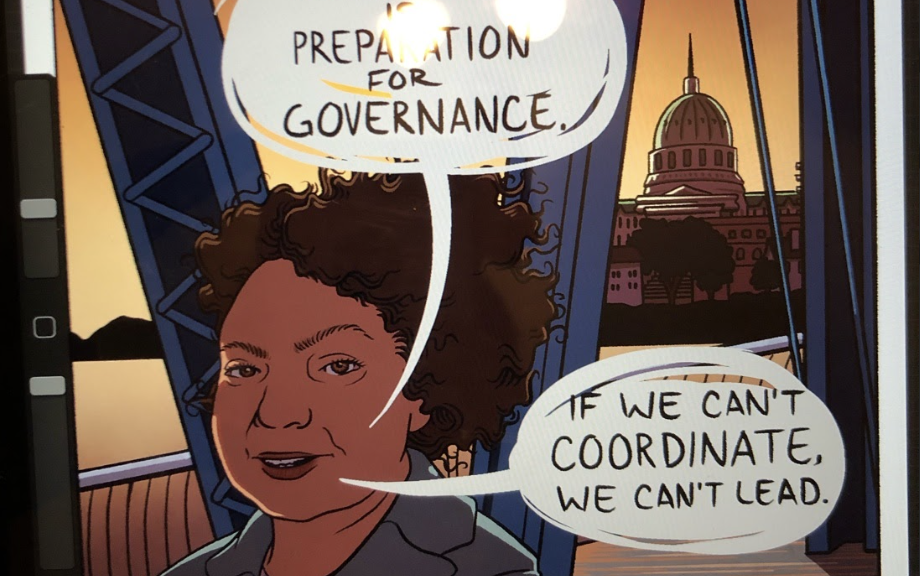
Leadership is lifting up the ideas and accomplishments of people who are not used to having their contributions recognized. It’s noticing when two people at a meeting pass a tray of cookies around and skip over a disabled person as if they weren’t even there. It’s working with someone to understand how to create and carry out a process. It’s making sure that people have the tools they need to get on a conference call. “There are millions of people in this country with little or nothing to lose. If they can be helped to take action together they will do so with a freedom and a power that is a new and unsettling force in our complacent national life.” Leadership is coordination to help people take action together. It’s communication, it’s interaction, it’s documentation, it’s outreach. A mantra of Brazil’s Landless Workers Movement (MST), one of the largest social movements in the world, is: “we all need to learn how to coordinate and be coordinated”. Coordination is not merely women’s work. Coordination is all of our responsibility. Coordination is the lifeblood of social movements. At its best, governance should be coordination. Not making decisions on behalf of people, but coordination of their participation and input. Coordination of processes that allow people to lead, and to be able to fulfill their needs. Coordination is the act of coming together to meet our needs. To organize to meet our needs and to build relationships and build society. Coordination is preparation for governance. If we can’t coordinate, then we can’t lead. How we get from there to here, who’s involved, who’s voice matters, what does the process look like, who does it include and exclude? How do we make sure everyone can participate? These are the questions of coordination. Coordination builds solidarity.
Devoted to the poor
We want people who are disillusioned with the political process because we want a new political process. We want the people who don’t vote or can’t vote because we can’t vote our way out of the situation that we’re in. We have to be devoted to the poor and dispossessed. Where the poor are, we are. We can’t expect people to come to us, we have to go to them. We have to respect them. We will not win by being “righter” than anyone else. We will not win by shouting down people who disagree with us. We will not win by rejecting people who disagree with us. We will win by welcoming them in.
What does the 1% want? If you want to know what the 1% wants, look at what the 1% funds. The rise of the “nonprofit industrial complex” has happened exactly as a new market ascendancy we call neoliberalism has arisen. It has happened exactly as the retrenchment of the state has happened. It has happened as welfare has been gutted, it has happened as public housing has been gutted. The non-profit industrial complex has arisen as productivity has completely been de-coupled from the value that is being created by workers in society. Is this an accident?
This sector has almost $2 trillion in revenue and employs over 10 million people. A significant part of that sector is based on the idea that the 1% can, through tax write offs, fund what is increasingly a legion of professional organizers and advocates to somehow bring about “social justice”. Another way to look at it as a job creator for a middle strata, a buffer zone of people between the rich and the poor, who make a living for themselves and their families based on the disintegration of society. So how does that 1% then channel our sense of what “social justice” is, our sense of what the solution is?
Through its funding mechanisms, of course. Where attention goes, energy flows. They cut the issues that are worth caring about and tell us who should care about them and what we should do about it. There’s no place for our strategy and our thinking. They let the world know that funding is available for “x” thing and then we rush out to get it, because it’s our livelihood. What’s not funded doesn’t get worked on. Strategies that they don’t approve don’t get worked on. People they don’t approve of or who don’t fit into their strategy don’t get organized.
The 1% can tolerate certain kinds of social change. It can tolerate some increasing diversity and representation in its ranks. It can tolerate anything that continues to lead to the Balkanization of the population and slicing up and isolating its potential resistance (which we then play into by fighting each other). It can tolerate moralistic “do-gooder” framing that essentializes certain groups as “good victims” while doing nothing to address the material roots of their oppression.
It can tolerate us working in issue silos that don’t bring those issues together into a comprehensive understanding of the system. It can tolerate us diminishing the importance of study and leadership development and elevating the importance of short-term mobilization on a repeated cycle, so that we don’t end up with increasingly sophisticated leaders in it for the long haul, but a constantly rotating cast of characters who are initially motivated by some trigger event but then burn out quickly. All these things it can tolerate. These are the waters we are swimming in, and every day in theory and practice we must ask ourselves, how are we outsmarting this strategy?